
A method is only worth the record behind it.
People seek progress. Businesses seek growth. Marketing creates value when it connects the two.
People are already trying to solve problems and move their organisations forward. A brand earns a role by helping them achieve that progress — and earns sustainable growth by creating value people can recognise, trust and experience.
One method, four disciplines
Every engagement runs the same four stages, whatever the deliverable turns out to be. Understand what is changing. Decide what matters most. Build the response. Learn what actually grew, and what didn't.
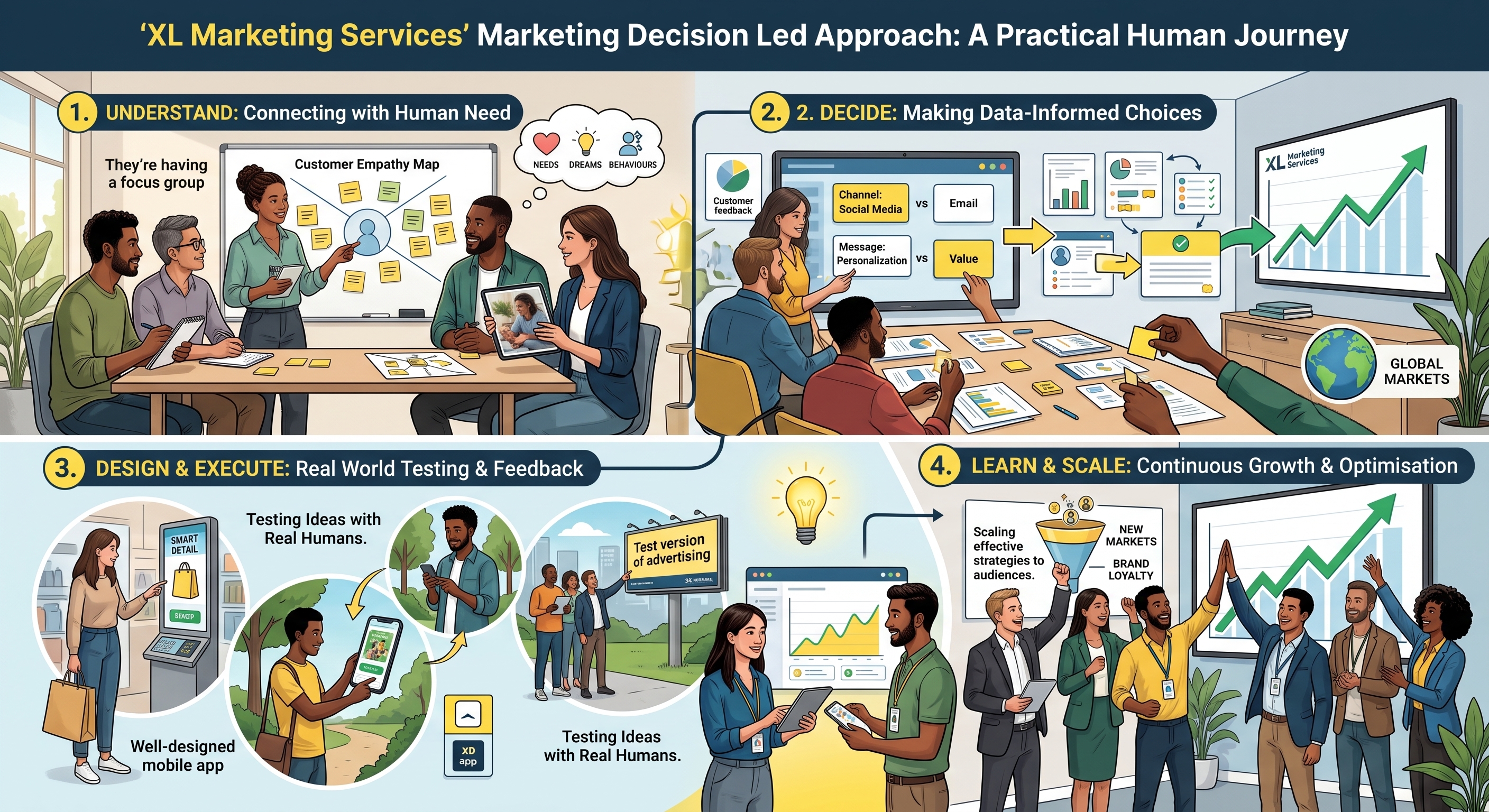
- Understand — map the progress your buyers are pursuing, and what stands in the way of it.
- Decide — locate the Crosspoint and name the single decision that will change the most.
- Design — build the brand, experience, communications and commercial activity that decision requires.
- Learn — measure what changed, what held, and what should happen next.
What needs to change for people and the business to move forward?
A more disciplined way to grow
Campaigns fail when they run on assumption. Before recommending anything, we assess your positioning, your content and your technical structure against what the market and your buyers are actually doing.
We look past the surface to find:
- The progress your buyers are trying to make, and what makes the decision hard for them today
- Where search and AI systems fail to find, understand or cite your business
- The role your brand can legitimately earn, rather than the one it would like to claim
- The measures that will show whether any of this is growing revenue, retention or share
What you get is a defensible basis for action — and the evidence to defend it in a room where the budget is decided.
The XL Crosspoint
The point where what your customers are trying to do and what the business needs to achieve meet, and both come out ahead.
- Human progress
- What are people trying to achieve?
- Business ambition
- What growth does the organisation need, and over what period?
- Brand contribution
- What useful role can this brand credibly earn?
- Conditions for breakthrough
- What has to change before any of it can work?
Better decisions start with better information. Where the facts are thin, the strategy will be too.
Authority comes with accountability. We define what marketing is expected to contribute, and we take responsibility for the part of it within our control.
- We work from evidence, not from the room. Internal conviction is not a market signal, and we will say so when the two disagree.
- We measure growth, not activity. Pipeline, retention, revenue and how often your brand is recommended by search and answer engines. Clicks and impressions tell you almost nothing about any of them.
- We mark where marketing ends. Product, pricing, sales and market conditions carry what they carry. Your board is entitled to know which one is the problem.
- We won't use language to cover for a system that isn't built. If the infrastructure is the issue, that is what the report will say. We design for informed, voluntary decisions, and we do not treat human limitations as something to exploit.
The same method, adapted to the decision in front of you
The same evidence-led method, adapted to the specific growth decisions you need to make today.
Is your marketing built to compound, or does it reset every quarter?
Twelve questions, about four minutes, and a directional answer you can act on. It is the cheapest way to find out whether the problem you are looking at is the one worth solving.
Then, if it's useful: book a results call to go through what it found.