A customer can be won before your website ever loads.
In March 2026, while building the website for Zero Click Marketing, SparkToro's Amanda Natividad asked Claude Code to recommend a tool for her contact form. Claude suggested Formspree.
She never visited Formspree's homepage. She signed up on the strength of the recommendation alone — becoming a customer, in her own words, "without experiencing the brand through any kind of marketing funnel."
XL had a similar experience. We also adopted Formspree after Claude recommended it to us.
In both cases, the decision was made before a website entered the picture. Standard analytics has no field for that. If a visit happens later, it gets logged as a direct visit — full credit for a decision it did not make.
Claude created the interest and closed the decision before Formspree's website ever came into it. Standard analytics has no way to register that.
Why buyers form opinions before visiting your website
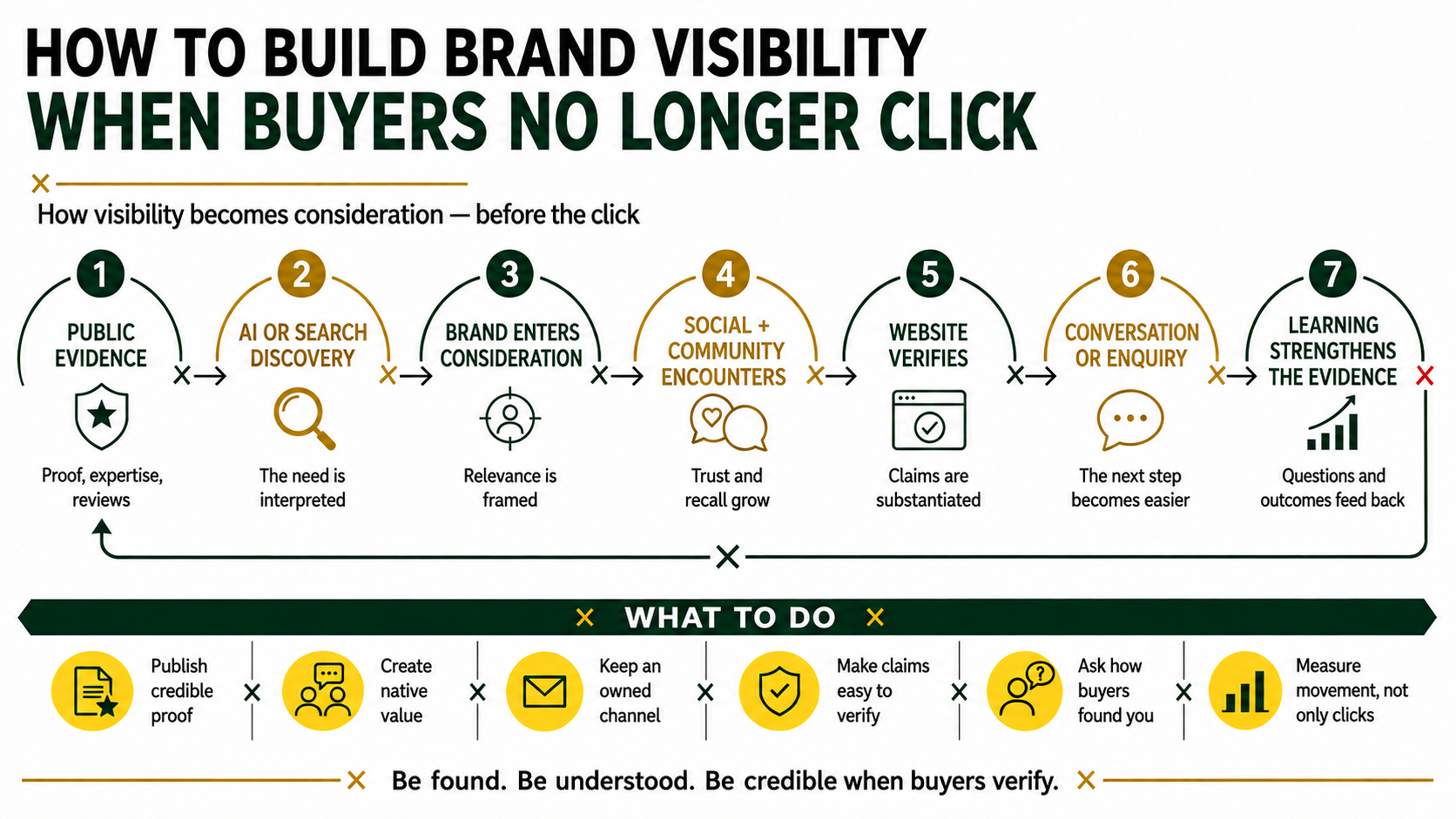
For years, businesses treated their website as the centre of the customer journey. Search engines, social media, PR and ads all aimed to drive traffic to the site, making page views the main measure of success. Today, buyers evaluate brands across many channels long before visiting a website.
The path to purchase is rarely direct. A buyer might discover a brand through an AI answer, a LinkedIn post, a podcast, a forum thread or a peer recommendation — just as it happened with Formspree. These touchpoints build trust without requiring an immediate click. They often lead to a direct site visit later, which standard analytics misattributes as the original source.
Research from SparkToro and Datos confirms that search happens across search engines, social networks, online marketplaces and AI tools. Traditional search engines still handle roughly 80% of searches, so Google still matters — but it is no longer the only place buyers discover options.
Your website might not make the first impression anymore. Its job is to provide the proof that makes that impression believable.
How AI tools place your brand on the shortlist
When someone asks an AI tool for a recommendation, the tool does more than surface links. It narrows down options and explains why one fits — combining brand awareness and initial evaluation into a single step, exactly as Claude did for Formspree.
As a result, buyers often arrive at a site already interested. The website does not need to introduce the business from scratch; it validates the AI's recommendation. Buyers visit to verify credibility, check reviews and confirm that the service meets their needs.
The absence of an immediate click does not mean the channel failed. What matters is whether the brand is on the shortlist when the decision gets made.
AI visibility is not just about getting mentioned. It is about joining the shortlist with solid evidence to back it up.
The difference between capturing demand and creating it
Amanda Natividad has written about the difference between channels that capture demand and the public evidence that creates it. A buyer might read a LinkedIn post, listen to a podcast, get an AI recommendation and then search directly for the brand. Search analytics logs the final visit, but the earlier touchpoints created the interest.
Public proof also informs what search engines and AI tools find and summarise. If the strongest case studies and expertise stay buried in offline conversations or internal documents, AI systems have nothing to draw on when generating a recommendation.
None of this requires sharing confidential detail. It requires publishing clear, verifiable proof: case studies, research, client testimonials, team credentials, clear service descriptions and accurate company information.
What each channel should achieve across the buyer journey
| Channel | Primary job | What content to publish |
|---|---|---|
| AI answer | Introduce the brand and explain relevance. | Clear company facts, verified client proof, accurate service summaries. |
| Search result | Show relevance clearly in search results. | Clear page titles, helpful descriptions, structured and crawlable content. |
| Personal LinkedIn | Earn attention through practical expertise. | Complete insights, real examples, useful advice directly in the feed. |
| Company page | Maintain the official company record. | Research, service updates, company news, verified results. |
| Build direct, owned subscriber relationships. | Standalone insights, practical guidance, simple next steps. | |
| Community or forum | Answer genuine buyer questions directly. | Helpful, non-promotional answers based on real experience. |
| Website article | Provide the definitive source and full proof. | Full analysis, data, source links, internal navigation. |
| Service page | Convert interest into a clear commercial offer. | Service scope, fit criteria, proof, pricing guidelines, clear contact step. |
A core message can travel across all of these channels, but copying identical text everywhere is ineffective. Tailor each piece to its platform while linking back to the same core proof on the website — the Formspree model, in reverse: earn the recommendation first, let the site confirm it.
How to plan content that drives practical results
Amanda Natividad's Content as a Service framework asks teams to define the audience, job to be done, moment of use and distribution plan before producing anything. It is built for content teams working alongside internal clients — the fuller version includes fields for source material, shelf life and internal ownership that a solo marketing function does not need in the same form.
The underlying discipline still applies: content should solve a real problem rather than fill a publishing schedule. Adapted for a single-brand context, the question before every piece becomes the same one XL asks of any decision: what specific action will this content help the reader take?
| Decision field | Question before production |
|---|---|
| Target audience | Who specifically needs this information to make progress? |
| Buyer task | Which decision, question or problem does this help resolve? |
| Moment of use | Where and when will the reader encounter this content? |
| Key obstacle | What misconception or uncertainty is stopping them from acting? |
| Evidence | What data, examples or evidence make this advice credible? |
| Platform value | What useful insight can the reader gain without needing to click? |
| Main record | Where does the full, updated version live on the website? |
| Next step | What action should become easier after consuming this content? |
| Success metric | Which signal shows real progress, beyond page views? |
| Review cycle | When should this content be reviewed, updated or retired? |
How to measure influence beyond website traffic
Tracking website traffic helps when a visit is required to complete an action, but traffic alone gives an incomplete picture. Click-through rates can fall even as brand awareness expands, and high traffic does not guarantee qualified sales leads.
A practical measurement framework connects early interest signals to business growth:
- Presence. Is the brand visible where potential clients research options and ask questions?
- Recognition. Is the brand's positioning and messaging easily recognisable across platforms?
- Clarity. Do prospects and AI tools accurately describe what the business offers?
- Proof. Are its insights cited in discussions, shared by peers or mentioned in sales calls?
- Engagement. Are brand-name searches, newsletter sign-ups and direct enquiries increasing?
- Commercial growth. Is the business attracting better-fit clients and higher-value opportunities?
- Continuous improvement. Which buyer questions and feedback should shape the next round of content?
This gives a clearer picture of the buyer journey than web analytics can provide on its own.
An eight-step publishing workflow
- Publish the complete article on the website as the primary record.
- Share practical takeaways on social channels, ensuring the advice is useful without requiring a click.
- Post updates on the company page connecting the core concept to the relevant service.
- Format key steps into visual carousels using the brand's own design system.
- Send an email newsletter that delivers the main insight directly in the email text.
- Use reader feedback and questions to plan future standalone posts.
- Track brand-name searches, direct visits, new enquiries and AI recommendations monthly.
- Update the primary website article whenever the offer or evidence changes.
How XL Marketing Services helps you build distributed visibility
Improving visibility is not about publishing more blog posts or adding keywords. It requires deliberate decisions about where target buyers spend time, what proof gets shared, and how each channel builds trust and preference.
XL's approach aligns audience needs with business goals to deliver value across every touchpoint, turning customer insight into coordinated growth.
The goal is not to force everyone to visit the website immediately. It is to ensure that wherever buyers encounter the brand, choosing it becomes easier — and the proof still holds up when they verify it.