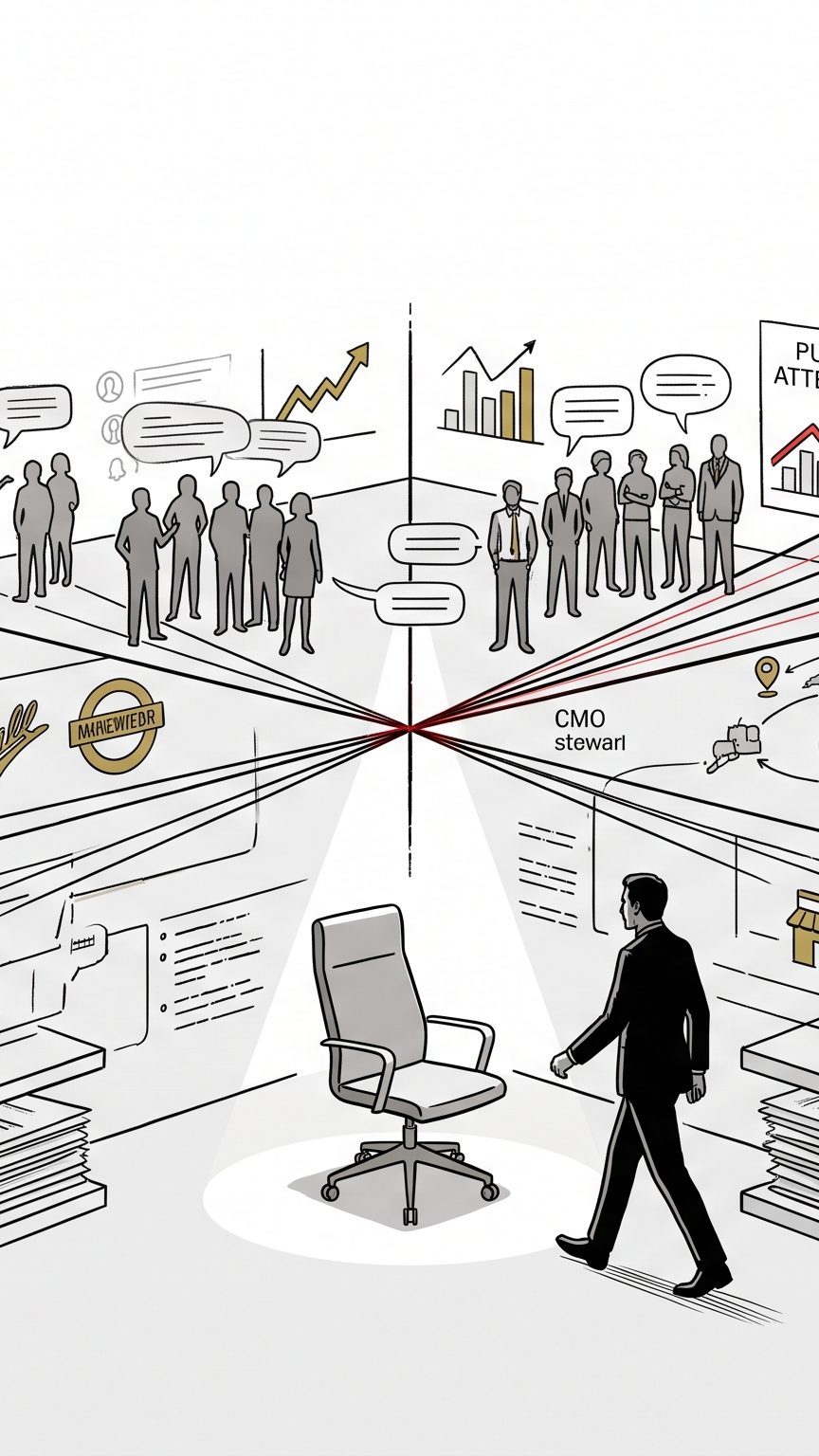
At Cannes, beneath the lights, lanyards and familiar language of industry influence, 50 portraits became shorthand for an extraordinary amount of power.
They represented Netflix, Nike, Visa, Hilton, BMW, Starbucks, Levi's, Mercedes-Benz, American Express and other brands that already occupy space in customer memory around the world.
Beside many of the names were the signals by which modern business recognises success: billions in revenue, expanding audiences, cultural relevance, customer growth and campaigns that travelled far beyond paid media.
The 2026 Forbes World's Most Influential CMOs list is impressive. It is also an invitation to ask a harder question.
When a marketing leader inherits a famous brand, how much of its present growth can reasonably be attributed to that individual?
Behind every portrait stands a much larger cast: former chief marketing officers, founders, product teams, salespeople, customer-service employees, engineers, retailers, distributors, agencies, creators, franchisees, regulators and investors. Behind them sit years—sometimes more than a century—of customer memory.
This does not diminish the current CMO. It helps us understand the role more accurately.
Brand growth is cumulative. A capable CMO inherits an asset, identifies what should remain distinctive, changes what is constraining relevance, and coordinates the organisation around the next source of value.
The most useful lesson from the Forbes list is therefore not that 50 exceptional individuals single-handedly created 50 successful brands. It is that marketing leadership becomes commercially consequential when it can mobilise an organisation's accumulated assets, present capabilities and future choices.

Influence is not the same as causation
Forbes describes its annual list as an assessment of marketing influence. The 2026 ranking, developed with Sprinklr and supplemental data from LinkedIn, began with more than 1,500 marketing leaders and examined more than 10 billion data points across 20 domains. Its stated dimensions include attention for marketing work, the attention and sentiment surrounding the CMO, and brand awareness and sentiment. The research period ran from April 2025 to March 2026.[1]
These measures tell us something meaningful. Attention affects who enters a customer's consideration set. Salience shapes who is remembered in a buying situation. Sentiment can strengthen or weaken the permission a company has to act. A visible marketing leader can attract talent, partners, media interest and investor confidence.
But influence is not a controlled experiment.
Placing a company's annual revenue beside a CMO's campaign record does not establish that marketing caused that revenue. Revenue may also reflect pricing, product quality, distribution, acquisitions, category demand, network effects, operational capacity, economic conditions and work undertaken long before the measurement period.
This distinction is particularly important when the list moves between companies as different as Netflix, Visa, Hilton, Snowflake, Ford and Airtel. A streaming service, payments network, hotel group, enterprise software platform, manufacturer and telecommunications operator do not create value—or make marketing visible—in the same way.
Forbes measures influence. A serious commercial analysis must go one step further and examine contribution.
Reputation is influence—even when it is uncomfortable
Influence is often discussed as if it were a favourable condition: admiration, attention, cultural relevance and the ability to move audiences.
Reputation makes the concept more complicated.
A reputation is a distributed judgement held by customers, employees, regulators, investors, governments, partners and communities. Those groups may not agree. A company can be loved by customers and questioned by investors. It can be commercially indispensable and politically contested. It can possess enormous brand strength while carrying memories of regulatory failure. It can publish strong financial results and still experience a sharp fall in market confidence.
Influence, then, is not synonymous with admiration. It is the capacity to shape attention, expectations, behaviour and institutional response—for better, worse or in ways that are difficult to attribute to one person.
Netflix and MTN make this tension especially visible.
Netflix: when fandom, financial performance and investor confidence diverge
Marian Lee, Netflix's chief marketing officer, placed first on the Forbes list for the third consecutive year. The recognition is understandable.
Netflix marketing is designed to turn programming into participation. A series does not end when the credits roll; it can continue through social conversation, creator activity, live experiences, consumer products, games and the audience's own cultural reinterpretation.
In a 2025 keynote published by Netflix, Lee described how a campaign that works for one title or country may be wrong for another. Marketing teams look for what makes a story culturally distinctive and create different portals through which fans can enter its world. Netflix judges much of this work by the conversation and fandom it creates—not only by impressions or a narrowly isolated return on advertising investment.[2]
This should not be surprising in 2026.
The existence of universal human emotions does not make their meanings, triggers or expressions universal. Ambition, belonging, fear, humour, status, safety and love can travel across borders while the stories, symbols, histories, languages and social conditions that make them relevant remain locally specific. Technology has also made it easier to adapt research, creative, media and customer journeys without distributing one execution unchanged across every market.
The persistence of locally irrelevant global campaigns is therefore not principally a technology problem. It is often an organisational one. Central teams may optimise for production efficiency, governance or global consistency while local teams are given responsibility for results without sufficient authority to shape the work. Research may be collected locally but overruled globally. Adaptation may be reduced to translation after the strategic and creative decisions have already been made.
Lee's approach matters not because she discovered that markets differ. That is table stakes. Its value lies in demonstrating that a scaled global organisation can preserve a recognisable brand and still give different titles, audiences and markets the freedom to find culturally credible expressions.
This is a critical crosspoint: the point where enduring brand meaning meets local market evidence and organisational authority. Consistency should protect the assets and strategic choices that help memory accumulate. It should not force every audience to receive the same story irrespective of context.
XL is best suited to organisations prepared to work at that crosspoint: companies that recognise universal human motivations without flattening cultural nuance, and that are willing to adapt strategy and execution when credible market evidence shows that relevance requires it.
That is a credible marketing contribution. It translates an enormous content portfolio into cultural moments and gives audiences reasons to return.
It is not, however, the whole Netflix growth story.
The CMO inherits a product available across more than 190 countries, a globally recognised interface, recommendation technology, a vast content and production system, established subscription behaviour and years of brand memory. Pricing, programming decisions, device distribution, product experience and international production all help create the conditions in which fandom can grow.
Events after the Forbes research window make the attribution question even more interesting.
Netflix published its second-quarter 2026 results on 16 July, several months after the March close of Forbes' measurement period. Revenue increased by approximately 13% year on year to US$12.6 billion and net income reached about US$3.4 billion. The business retained strong margins and expected approximately US$3 billion in advertising revenue for the year.[3]
Yet viewing hours increased by only 2% in the first half, and the company's outlook did not satisfy every investor expectation. Its shares fell sharply in after-hours trading, as Associated Press reported following the results.[4]
Nothing in this picture supports a simplistic judgement that Netflix had suddenly become a weak brand or that its marketing influence had disappeared. It shows that several truths can exist at once:
- The brand can remain culturally powerful.
- The company can continue producing strong revenue and profit growth.
- Fandom can be a valuable marketing outcome.
- Engagement growth can still concern investors.
- Market confidence can respond to expectations that sit beyond the CMO's authority.
This is why reputation must be considered across stakeholders. The audience watching Bridgerton, an advertiser considering Netflix inventory and an investor modelling future growth are not making the same decision.
The CMO's task is not to control all three. It is to understand how the brand, proposition and customer experience contribute to each—and where another executive or organisational capability owns the outcome.
New Balance: making an inheritance commercially useful
New Balance offers a different form of cumulative growth.
The company was founded in 1906. Its manufacturing heritage, product associations and independent ownership were not created by current Global Brand President and CMO Chris Davis. Neither was the accumulated familiarity of a brand that had travelled through performance sport, specialist running and the much-parodied territory of the “dad shoe”.
Davis's contribution appears to be the conversion of that inheritance into a coherent growth platform.
“Fearlessly Independent Since 1906” gives the organisation a principle that can govern more than advertising. Under his leadership, New Balance has connected positioning with product architecture, merchandising, athlete relationships, luxury collaborations and demand generation across 130 countries. Its partnerships with athletes including Coco Gauff and Shohei Ohtani and brands including Miu Miu and LVMH-related houses have allowed performance credibility, culture and fashion to reinforce one another.[5]
The company's reported sales more than doubled between 2021 and 2025, reaching US$9.2 billion. Davis has also described a 50–30–20 investment framework balancing proven tactics, calculated risk and higher-risk experimentation. But even here, responsible attribution requires context. Growth coincided with the wider return of retro-running silhouettes, the convergence of sport and fashion, retail expansion, competitor difficulties, product availability and the performance of its athlete partners.[6]
The value of Davis's leadership is not that he invented New Balance's independence. It is that the company made independence useful.
The position informed whom the brand partnered with, how it entered new sporting categories, how it allocated investment and how it balanced proven activity with experimentation. Strategy became a decision system.
This is the difference between inheriting distinctive brand assets and merely preserving them in an archive.
Cathay Pacific: brand recovery cannot fly ahead of operational recovery
Cathay Pacific was not selected for this analysis because it is Asia's most valuable airline. It is not. It is included because recovery reveals the limits and responsibilities of marketing unusually clearly.
Hong Kong's extended pandemic restrictions disrupted routes, staffing, capacity and international movement. Cathay's marketing challenge was therefore never simply to create a more contemporary campaign. The organisation had to rebuild the experience that made the promise believable.
General Manager of Brand, Insights and Marketing Communications Edward Bell helped establish the “Move Beyond” philosophy and later the more emotionally immediate “Feels Good to Move” campaign. In his discussion of the latter with Campaign, the work sought to connect Cathay with younger and more global audiences and move beyond the immaculate—but potentially distant—visual conventions of premium aviation.[7]
The strategic shift was meaningful. So was its timing. As people began moving again, Cathay could reconnect travel with the visceral human desire for progress, discovery and contact.
Brand Finance reported a 45% increase in Cathay Pacific's brand value in 2026, the second-highest percentage increase among airline brands globally. That is useful evidence of renewed momentum, but it is not proof that communication alone produced it.[8]
Routes had to return. Aircraft had to fly. Employees had to deliver. Cabins, lounges, schedules, digital touchpoints and service recovery had to support the proposition. Hong Kong's wider aviation and tourism ecosystem also mattered.
Bell inherited Cathay's premium associations and long history. The marketing contribution was to decide which equities should remain, what expression had become constraining and how the brand could re-enter a changed world.
The case carries an important warning for any consultancy or agency: marketing cannot communicate an organisation out of an operational reality. The work becomes valuable when it helps the organisation align the promise, product and experience.
Bharti Airtel: some of marketing's most consequential work reduces friction
Siddharth Sharma is Director of Marketing at Bharti Airtel and CEO of its Connected Homes business. Forbes correctly identifies his country as India. Bharti Airtel is an Indian multinational headquartered in New Delhi; it should not be confused with an African-headquartered brand or presented as Africa's representative on the list.
The source of possible confusion is understandable but important to resolve. Airtel Africa is a separate, London-listed telecommunications company operating across African markets, and Bharti Airtel is its controlling shareholder. Sharma's listed remit concerns Bharti Airtel and Connected Homes in India—not the marketing leadership of Airtel Africa.
Its importance to this analysis lies elsewhere.
Sharma's remit spans broadband, connected homes, entertainment and data-led services in India. In a market of extraordinary scale and diversity, brand growth depends on more than cultural visibility. It can depend on whether technology feels understandable, services remain accessible, networks are reliable and customers believe that the company can protect them from fraud.
Airtel's “Safe Network” work, its AI and technology partnerships and its emphasis on simplicity illuminate a dimension of marketing that global creative rankings can undervalue.
Some of marketing's most commercially consequential work is not the creation of attention. It is the reduction of uncertainty, risk and friction at scale.
This type of influence may be less visible in English-language marketing media. It may produce fewer celebrity campaigns or conference conversations. But it can change whether a household adopts broadband, whether a customer trusts a digital service and whether complex infrastructure becomes meaningful in everyday life.
Bharti Airtel belongs in the discussion not as “Africa's answer” to an American list, but as an Indian case of product marketing, trust and adoption operating at exceptional scale.
The geographical roles in this analysis should therefore remain distinct:
| Leader or brand | Geography | Role in our analysis |
|---|---|---|
| Siddharth Sharma, Bharti Airtel | India | Emerging-market adoption, simplicity and trust |
| Edward Bell, Cathay Pacific | Hong Kong/China designation | Asian brand recovery and operational alignment |
| MTN | African-headquartered, not represented | Test of regional value versus globally measurable influence |
India is represented on the Forbes list. African-headquartered marketing leadership is not. MTN enters this analysis not as a correction to Sharma's identity, but as a test of whether globally measured influence captures regionally consequential brand leadership.
MTN: Africa's most valuable brand—and the influence the list does not capture
If Bharti Airtel demonstrates emerging-market adoption in India, MTN presents a sharper challenge to the Forbes frame from Africa.
Brand Finance named MTN Africa's most valuable brand in 2026 for the thirteenth consecutive year, valuing it at approximately US$2.9 billion. MTN operates across 16 markets and ended 2025 with more than 307 million voice customers, 172 million data customers and 70 million Mobile Money customers.[9]
No MTN marketing leader appears in the Forbes 50.
This does not prove that the ranking is wrong. It raises a legitimate question about the influence that its methodology can see.
MTN's reputation carries both achievement and institutional memory. The company has helped expand connectivity, data access and financial inclusion across markets where telecommunications infrastructure is intertwined with economic participation. Its brand is not merely encountered in advertising; it is experienced through network availability, price, mobile money, customer service and the ability to remain connected.
It has also faced consequential regulatory and operating difficulties.
In 2015, Nigeria's communications regulator imposed a major fine relating to the late disconnection of approximately 5.1 million subscribers whose registrations were considered incomplete, as MTN disclosed in its financial reporting. The matter was eventually settled at N330 billion and the final payment was completed in 2019. The episode cannot responsibly be reduced to a communications problem. It concerned compliance, security, governance and the company's relationship with a nation state.[10]
More recently, MTN's Nigerian performance was severely affected by the devaluation of the naira, foreign-currency pressure and the economics of operating energy-intensive infrastructure in a market with persistent power instability. These were not failures that a more culturally celebrated campaign could resolve.
The consequences nevertheless affected reputation and brand value. Brand Finance reported a 26% fall in MTN's brand value in its 2025 South African ranking, linking the decline partly to Nigerian market conditions, revenue pressure, risk and weaker brand strength.[12]
Then the picture moved again.
MTN reported strong 2025 results in March 2026. Group service revenue rose to R218 billion, the customer base passed 300 million and MTN Nigeria delivered strong constant-currency service-revenue growth. The company said its reputation and trust scores were the highest recorded since it introduced its Reputation Index Survey in 2019.[11]
MTN therefore resists a clean label. It is neither a cautionary tale nor an uncomplicated African champion.
Its influence is diffuse:
- Customers encounter the brand as infrastructure and service.
- Regulators encounter it as a systemically important licensed operator.
- Governments encounter it as an investor, taxpayer and development participant.
- Investors encounter currency, policy and geopolitical exposure.
- Communities encounter connectivity and financial inclusion alongside affordability and service expectations.
This is reputational power, but not always the kind that announces itself through marketing attention.
The absence of MTN from the Forbes list may reflect regulatory history, weaker global executive salience, data-source visibility, the list's enterprise-level eligibility choices or simply the performance of other candidates. Without access to the full scoring, it would be irresponsible to identify one cause.
The more useful observation is this: a brand can be regionally indispensable, economically significant and highly valuable without its marketing leadership becoming globally legible as “influential”.
Whose influence becomes visible?
Approximately two-thirds of the 2026 Forbes list is attached to the United States in the publication's own country labels. Europe has a smaller presence. Asia-Pacific and India appear selectively. African-headquartered marketing leadership is absent, while the Middle East and Latin America are also strikingly limited or absent as headquarters locations.
This does not mean influential marketing leaders do not exist in those regions. It suggests that influence depends partly on the system through which it is observed.
When a methodology uses media attention, online salience, brand conversation and LinkedIn data, it may favour:
- Leaders operating in large English-language media markets;
- Consumer brands that regularly generate public conversation;
- Executives with established personal visibility;
- Companies whose marketing activity is well documented online;
- Categories in which influence is expressed through culture and communication.
B2B leadership, public-infrastructure brands and regionally consequential work may create value less visibly. A telecommunications operator improving rural coverage, an enterprise marketer strengthening buying-committee confidence or a bank building trust through compliance and availability may not produce the same volume or type of public attention as a global entertainment campaign.
The issue is not sponsorship speculation or a claim of deliberate exclusion. The issue is construct validity: does the measurement capture the full concept it is named for?
The Forbes list is best understood as a valuable view of measurable marketing influence—not the final global account of marketing leadership.
A framework for evaluating CMO contribution
Boards, CEOs, investors and agencies need a more disciplined way to discuss marketing's contribution without either exaggerating or dismissing it.
Six questions provide a useful starting point.
- What equity did the leader inherit? Examine existing recognition, associations, distinctive assets, customer relationships, distribution and cultural meaning. A new CMO at Nike and a first marketing leader at an unknown technology company do not begin with the same asset.
- What did the leader demonstrably change? Identify decisions made during the person's tenure: positioning, proposition, portfolio, partnerships, operating model, customer experience, capability, measurement or investment allocation. Separate evidence from flattering proximity to company performance.
- Which organisational capabilities made the intervention possible? Marketing rarely acts alone. Product, sales, service, data, operations, finance, agencies, distribution partners and executive sponsorship determine whether the strategy can be delivered.
- What was happening in the market? Category growth, competitor weakness, regulation, currency movements, technological adoption and cultural change can accelerate or obstruct performance. A strategy should be judged in the conditions in which it operated.
- Which outcomes were actually observed? Revenue alone is insufficient. Depending on the decision, relevant evidence may include penetration, adoption, pricing power, availability, qualified demand, pipeline progression, retention, brand strength, customer behaviour, cost efficiency or organisational capability.
- How strong is the connection between intervention and outcome? Was there a clear mechanism? Were measures established before activity began? Did the outcome occur in the intended audience or market? What else changed at the same time? What remains outside marketing's authority?
This is not a demand for perfect attribution. Perfect attribution is rarely available. It is a demand for intellectual honesty.
What smaller organisations should learn
The wrong lesson from the Forbes list would be to imitate the visible outputs of famous brands. A smaller company cannot create Netflix's fandom by commissioning more social content. It cannot reproduce New Balance's growth by signing a fashionable collaborator. It cannot borrow Cathay's emotional language without delivering the experience, or Airtel's language of trust without dependable infrastructure.
What organisations can adopt is the discipline beneath the work:
- Protect the distinctive assets that already carry memory.
- Diagnose the constraint before changing the identity or adding activity.
- Connect positioning to product, distribution, customer experience and sales.
- Understand the different decisions made by customers, regulators, partners and investors.
- Give marketing authority only where accountability can reasonably follow.
- Measure the contribution marketing was designed to make.
- Preserve organisational learning so the next leader does not restart the brand from zero.
The same standard should apply to agencies and strategic partners.
The right agency does not enter an organisation to erase institutional memory, impose a fashionable system or claim every favourable result. It helps leadership recognise what the business already owns, identify what is obstructing progress and coordinate the capabilities required to create the next source of value. See how XL applies this discipline through Marketing Decision-Led Growth →
That work may produce a campaign. It may instead require sharper positioning, a better route to market, clearer sales context, stronger customer evidence, a more coherent authority system or the decision not to add another activity at all.
The next chapter is a collective achievement
The mythology of the singular marketing genius is attractive because it gives every success a face. Business reality is less tidy and more interesting.
Marian Lee did not invent Netflix's technology, content library or global distribution. Chris Davis did not create New Balance's century of independence. Edward Bell did not reopen Hong Kong or restore airline capacity alone. Siddharth Sharma does not build every network connection through marketing. MTN's reputation cannot be located in one campaign, one regulator or one executive.
Each leader works inside an inheritance.
The capable ones recognise its value without becoming trapped by it. They protect what makes the brand easy to recognise and meaningful to customers. They challenge what no longer serves the market. They build the organisational confidence to make choices across product, experience, communication and commercial action.
And then they leave another inheritance for the team that follows.
That may be the most important form of marketing influence: not the attention attached to one leader, but the value the organisation remains capable of creating after the spotlight moves on.