A marketer opens a blank document at 08:15. By 08:18, an AI tool has supplied ten headlines, three email variations, a video script and enough social copy to fill the week. The production problem appears solved.
Then the harder questions arrive. Which claim can the brand defend? What has this added to the market? Why should a customer trust it? What decision should become easier after reading it? And when leadership asks what the content contributed, which evidence will answer them?
That is the content paradox of 2026: organisations can produce more than ever, yet the ability to create something recognisable, useful and commercially accountable has become more scarce.
What does HubSpot's 2026 report actually say about content?
HubSpot's 2026 State of Marketing research presents a market in which AI is embedded in everyday work. Eighty per cent of marketers use AI for content creation and 75% use it for media production. At the same time, 83% say the arrival of AI means they are expected to produce more than before, and 80% of teams plan to maintain or increase their content budgets in 2026.[1]
Greater capacity has not automatically produced greater effectiveness. HubSpot reports that 52% of marketers believe AI has made content so easy to create that it is less effective overall. A further 53% say they struggle to differentiate their work in an AI-saturated market.[1]
The report's leading content-marketing challenge is creating material that receives high levels of online engagement, selected by 35% of respondents. Finding new ideas follows at 28%, with consistent production at 27%.[1]
Correction for publication. The widely repeated 45% figure does not describe content quality as marketers' number-one challenge. In the supplied HubSpot report, 45% identifies website/blog/SEO as the most-leveraged marketing channel. Accuracy here matters: authority is weakened when an arresting statistic is attached to the wrong question.
Why does more content produce less distinction?
When a capability becomes widely available, possession of the capability stops being an advantage. AI-generated fluency is following that pattern. Clean grammar, orderly structure and rapid repurposing are useful, but they are becoming the minimum standard rather than proof of strategic quality.
Shared tools create shared patterns. The same models are trained on overlapping bodies of material. When briefs are broad and prompts are generic, outputs tend to converge around familiar claims, structures and phrases.
Volume weakens editorial choice. When output becomes effortless, teams can confuse the ability to publish with a reason to publish. The editorial question shifts from "Can we make this?" to "Does this deserve the audience's attention?"
Personalisation can become cosmetic. Changing a name, image or subject line is not the same as understanding a person's context. HubSpot reports that 93% of marketers associate personalisation with improved leads or purchases, yet only 65% say they possess high-quality audience data.[1][2]
Teams optimise the artefact, not the decision. A post may be readable, searchable and visually polished while doing little to reduce uncertainty, answer an objection or help someone choose what to do next.
What is high-quality content in an AI-saturated market?
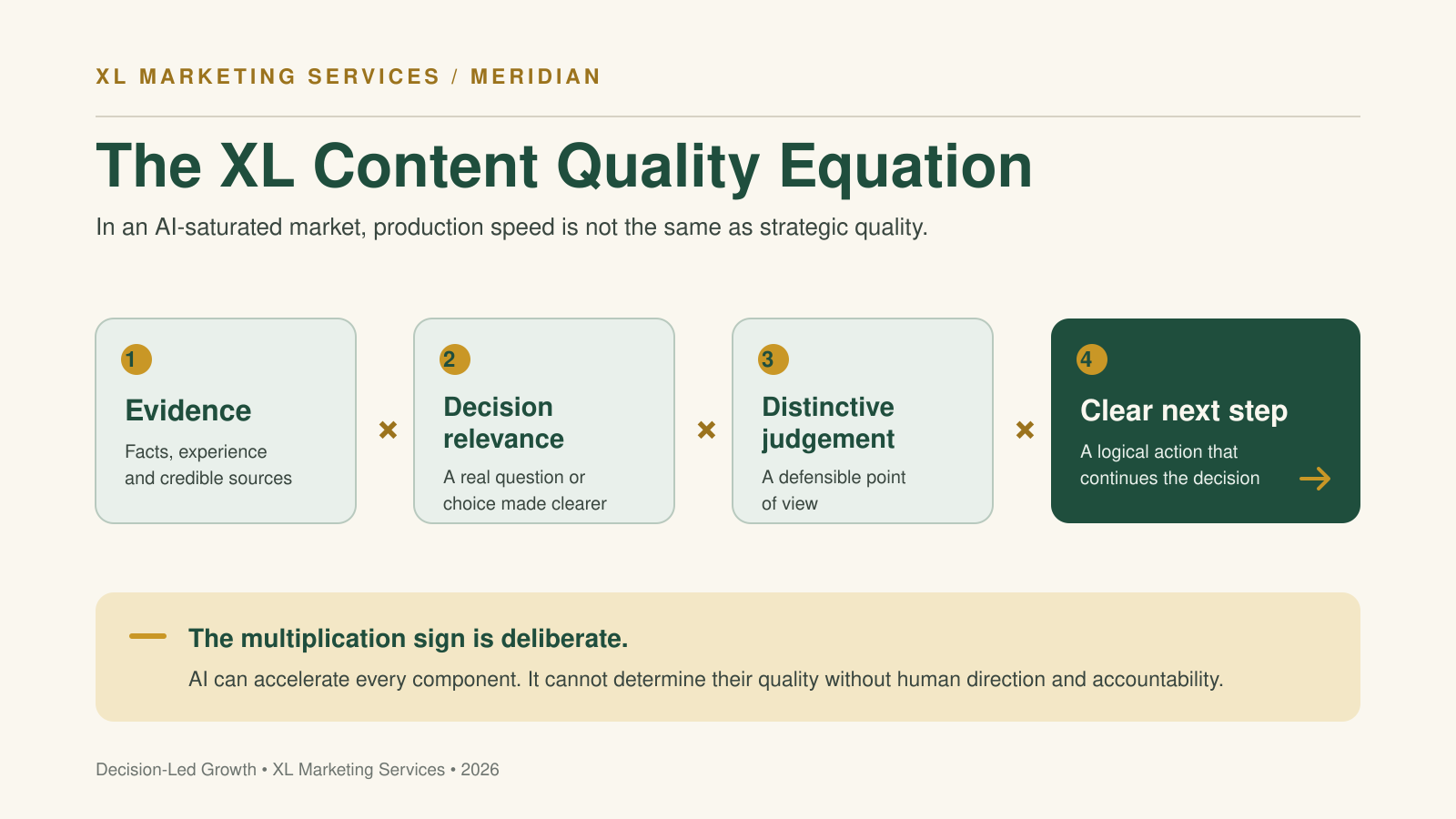
Content quality is the degree to which content helps a specific audience make a better decision through credible evidence, distinctive judgement and a clear next step.
This definition deliberately moves quality beyond style. A beautifully written article can still be weak if it repeats the category, obscures its evidence or leaves the reader no better equipped to act.
Decision-led content has five characteristics:
- Evidence. It distinguishes verified facts from interpretation and clearly identifies the source, sample and date.
- Decision relevance. It answers a real question attached to a customer, buyer or leadership decision.
- Distinctive judgement. It contributes a defensible point of view rather than paraphrasing consensus.
- Human accountability. A named person or organisation is responsible for the analysis, corrections and recommendations.
- Commercial learning. Its performance changes what the organisation understands or does next.
Is the content-quality problem different in B2B and B2C?
Yes — but not because one audience is rational and the other emotional. Every decision contains functional, social and emotional pressures. The difference lies in the configuration of risk, scrutiny, time and participation.
| Decision pressure | B2B content | B2C content |
|---|---|---|
| Audience | A buying group may include users, technical evaluators, procurement, finance and executive sponsors. | The buyer is often an individual, but household, community and social influences still shape the choice. |
| Primary burden | Build consensus, reduce organisational and career risk, and justify value over a longer decision. | Earn attention quickly, demonstrate relevance and create confidence at the moment of choice. |
| Evidence | Expertise, implementation detail, business cases, compatibility, proof and credible commercial outcomes. | Product experience, social proof, service quality, values, convenience and a fair personal-data exchange. |
| Trust risk | Generic content signals shallow expertise and gives internal champions little material with which to defend a choice. | Over-personalisation or opaque AI use can feel intrusive, manipulative or careless. |
| Useful next step | A diagnostic, comparison, working session, technical explanation or stakeholder-ready business case. | A demonstration, review, trial, recommendation, offer or low-friction purchase and service experience. |
The B2C evidence adds an important warning. Salesforce reports that 73% of customers feel companies treat them as individuals, but only 49% believe companies use their information in ways that benefit them. Seventy-one per cent are increasingly protective of their personal information, 64% believe companies are reckless with customer data and 72% say it is important to know when they are communicating with an AI agent.[3]
Klaviyo's B2C research similarly places retention, connected customer experience and marketing-service alignment at the centre of growth. Its 2025 report draws on more than 1,500 marketers worldwide, while its consumer research draws on more than 8,000 global consumers.[4][5]
The juxtaposition is revealing. B2B content fails when it cannot withstand scrutiny. B2C content fails when personalisation outruns trust. In both cases, the remedy is not more words. It is better evidence and better judgement.
How should organisations improve AI-assisted content quality?
- Begin with the question, not the keyword. Define the decision the audience is trying to make, the uncertainty blocking it and the evidence needed to reduce that uncertainty. Search terms then help reveal how the question is expressed.
- Build an evidence pack before drafting. Collect customer language, subject-matter expertise, first-party data, credible third-party research, counter-evidence and proof. An AI system should organise this material, not invent the missing substance.
- State the brand's point of view. HubSpot frames point of view as a competitive advantage and reports that 85% of marketers revisit brand identity quarterly or annually.[1] A point of view should identify what the organisation believes, why it believes it and what the belief changes for the customer.
- Design for extraction without flattening the writing. Use a direct answer, descriptive headings, concise definitions, tables only where comparison helps, visible sources and self-contained passages. These features help people scan and help search and AI systems understand what each section establishes.
- Measure progression, not output alone. Track whether the content generates qualified enquiries, supports sales conversations, earns citations, improves assisted conversion, resolves objections or advances retention. Traffic and engagement remain useful signals, but neither is the commercial decision.
- Create a learning loop. Feed search queries, customer questions, sales objections, service conversations, AI-search visibility and conversion behaviour back into the editorial system. The next content decision should be better because the previous one produced evidence.
Can content be written for people, search engines and LLMs at the same time?
Yes. The requirements overlap more than they conflict. People need clarity, relevance and confidence. Search engines need accessible, well-structured and authoritative information. LLMs need passages whose claims, entities, definitions and sources can be interpreted without guessing.
The mistake is to write three different articles inside one page: an emotional introduction for people, repetitive keywords for search and disconnected fact blocks for AI systems. A stronger approach begins with a genuine question and answers it at several levels of depth.
- The opening gives the shortest accurate answer.
- The body explains the evidence, implications and limits.
- Definitions and comparisons are written as self-contained, attributable passages.
- Sources show where the evidence ends and XL's interpretation begins.
- The conclusion connects understanding to an appropriate next decision.
Not sure whether these signals are present across your own digital footprint? Assess your AI visibility →
The advantage has moved
The blank page once slowed marketing down. It also forced a moment of choice. AI has removed much of that pause. The strategic task is to put judgement back into the system deliberately — the discipline XL calls Marketing Decision-Led Growth.
In 2026, the strongest content operation will not be the one that produces the largest library in the shortest time. It will be the one that knows which questions deserve an answer, which evidence can be trusted, which point of view the brand can own and which customer or commercial decision the work should improve.
Content is easier to make. Meaning is not. That is precisely why judgement has become the advantage.
Next step. If your organisation is producing more content without clearer evidence of what it changes, XL Marketing Services can help assess the positioning, decision logic, evidence base and measurement system behind it. Explore Brand Positioning & Messaging, or see how the same discipline applies to broader marketing decision-making.