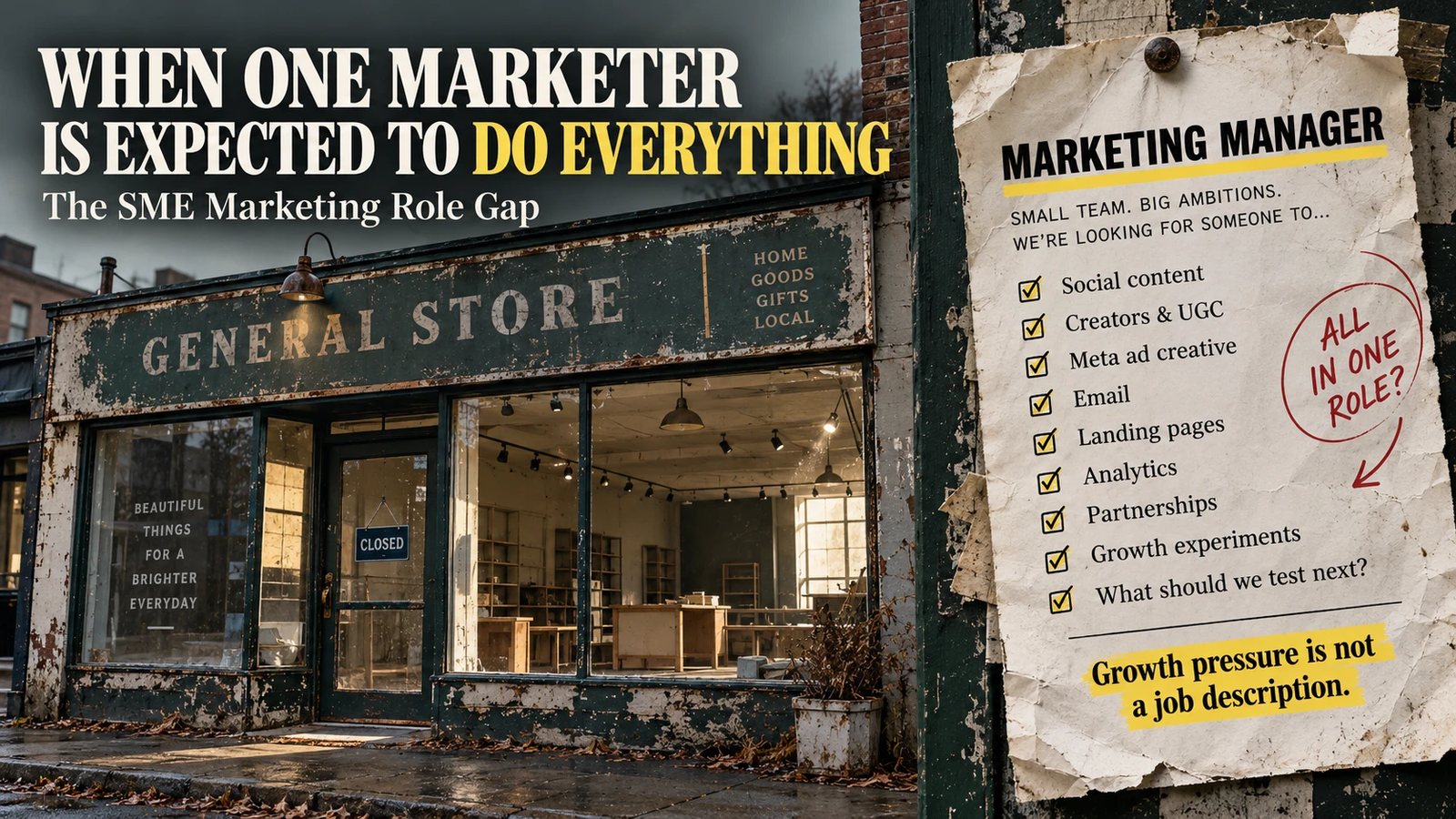
There is a particular kind of marketing job description that appears when a business is already under pressure.
Revenue has slowed.
Growth feels less predictable.
The founder wants answers quickly.
Then the brief lands.
The new marketer is expected to manage social media, produce content, coordinate creators, write email campaigns, develop Meta creative, improve landing pages, analyse performance, identify partnerships, test offers, generate leads and somehow connect all of it to revenue.
On paper, the business is recruiting a marketer.
In practice, it may be asking one person to inherit the business growth problem.
That distinction matters.
Because the problem often begins before the hire.
The hire frequently comes after the pressure
Many small businesses do not build formal marketing capability early.
That is understandable.
In the beginning, founders sell. Referrals bring customers. Word of mouth creates momentum. Sales activity fills some of the gaps. Limited resources go towards the product, delivery and keeping the business operating.
Marketing can feel like something to formalise later.
Until later arrives.
Growth slows. Acquisition becomes more difficult. Competitors become more visible. Revenue targets start to feel harder to reach.
Suddenly marketing moves from “something we should invest in” to:
“We need customers. Now.”
That is a very different starting point for a hire.
The new marketer is no longer simply being asked to build future demand.
They may also be expected to repair years of accumulated marketing debt while producing immediate commercial results.
Marketing debt is different from marketing workload
The workload is easy to see. Posts need to be created. Campaigns need to launch. Ads need creative. Email needs copy. Reporting needs to happen.
But beneath the visible activity can sit a second problem: marketing debt. That may include:
- unclear positioning;
- limited customer research;
- inconsistent messaging;
- weak customer evidence;
- poor CRM data;
- no clear lifecycle view;
- little understanding of where leads are lost;
- fragmented sales and marketing processes; or
- no reliable way to distinguish profitable customers from unprofitable ones.
A marketer inheriting that environment does not simply have “a lot to do”.
They are being asked to operate a system that has not yet been properly built.
And that is when workload begins to disguise a deeper problem.
Urgency makes channels look like strategy
When commercial pressure is high, businesses understandably want action.
The conversation quickly moves towards tangible solutions.
“We need someone to run LinkedIn.”
“We should start Meta ads.”
“We need to post more.”
“We need SEO.”
“We need someone to manage content.”
There is nothing inherently wrong with any of those activities.
The problem is the order in which the decision is made.
A channel has been selected before the business has established where growth is actually breaking down.
That is backwards.
The first question should not be:
Which channel should we use?
It should be:
What is currently preventing more of the right customers from buying, returning or recommending us?
Only then does the channel decision become useful.
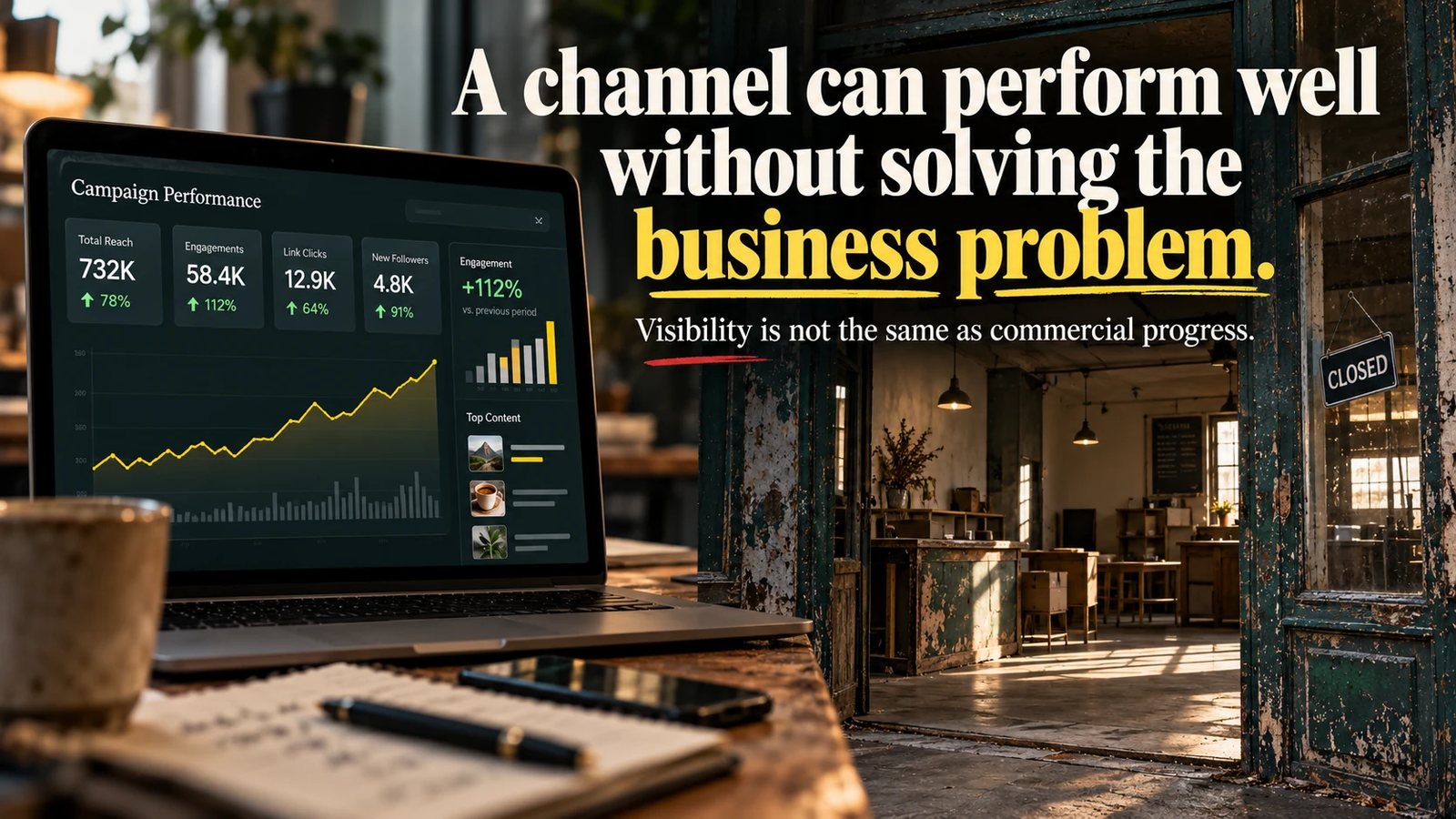
A channel can perform well without solving the business problem
This is one of the easiest marketing traps to fall into because the dashboard can tell a very convincing story.
Reach rises. Followers increase. Engagement improves. Traffic grows.
The campaign looks successful.
But if those people are unlikely to buy, the business problem remains.
A business can therefore experience something that feels contradictory:
the marketing activity works while the commercial outcome does not.
That happened in a business I was involved with.
We were under pressure to grow sales and identified a category that appeared to generate significant interest in the market.
We built a community-growth campaign around it.
The campaign succeeded at attracting attention. Follower numbers increased. Engagement improved.
But the audience we attracted was not necessarily the audience most likely to become valuable customers.
Many were highly responsive to promotions and giveaways. They liked the category. They enjoyed the content.
But attention did not translate into the customer growth we needed.
The channel had performed.
The diagnosis was not correct.
That lesson has stayed with me:
A marketing metric can improve while the business remains stuck.
Sometimes the market itself has been misread
The deeper issue in that case was not the platform.
It was our interpretation of how customers made decisions.
We had placed too much emphasis on the premium experience as the initial driver of customer choice.
What we underestimated was the role price played in the first purchase.
Customers could choose between multiple providers. Price often influenced the initial decision. Experience then affected whether they returned, recommended the service or simply moved to the next supplier.
For a smaller or less familiar brand, that dynamic becomes even more difficult.
Marketing science has long observed the Double Jeopardy pattern: smaller brands tend to have fewer buyers and slightly lower loyalty than larger brands.[1]
That does not mean smaller businesses cannot have loyal customers.
It means they should be cautious about assuming loyalty will compensate for low penetration.
The business still needs enough people to buy.
And then it needs to give them enough reason to return.
If operational delivery is unreliable, acquisition becomes even more expensive because new customers constantly need to replace those who leave.
Marketing can attract demand.
It cannot guarantee that the rest of the organisation retains it.
That is why the role should follow the customer profile and journey
Most marketing roles are still written around familiar disciplines:
- Social media manager.
- Brand manager.
- Content marketer.
- Performance marketer.
- SEO specialist.
- Growth marketer.
- CRM manager.
There is nothing wrong with those categories.
But for a small business, the better starting point may be the customer journey.
Ask:
- How do customers first discover us?
- What happens after that?
- Where do they compare us?
- What gives them confidence?
- What causes hesitation?
- What happens between enquiry and purchase?
- Where are prospects lost?
- Why do some customers return while others disappear?
Those questions reveal which capability the business actually needs.
The answer may indeed be social media. It may be paid acquisition. It may be lifecycle marketing.
But it could also be positioning, conversion, sales follow-up, customer evidence, onboarding or service delivery.
The role should emerge from the problem.
What the role says versus what the business needs
This is where overloaded job descriptions become revealing.
The role says: Content.
The business may need better positioning.
The role says: Meta ads.
The business may need a stronger offer.
The role says: Email marketing.
The business may need a clearer retention strategy.
The role says: Analytics.
The business may first need to decide what success actually means.
The role says: Growth.
The business may not yet understand where growth is constrained.
One marketer can understand how those pieces connect.
That does not mean one marketer should be expected to personally execute and own all of them.
There is an important difference between system understanding and execution ownership.
A growth marketer may need to understand how landing-page conversion affects acquisition economics. That does not mean they need to design, build and maintain every landing page.
They may need to understand how creator content contributes to paid media. That does not mean they should personally source, brief, negotiate with and manage every creator while also running campaigns.
They may need to understand retention. That does not automatically make them responsible for customer-service failures.
Integration requires visibility across the system. It does not require one person to become the system.
Before hiring, diagnose four things
A small business can reduce this problem considerably by answering four questions before writing the role.
1. Where is growth breaking down?
Is the business struggling with discovery, conversion, retention, pricing, customer experience or something else?
2. Where does that breakdown occur in the customer journey?
Be specific.
“Marketing isn't working” is not a diagnosis.
“Qualified prospects visit the site but abandon before enquiry” is much closer.
3. What capability would improve that point?
Is the missing capability strategic, creative, analytical, technical, operational or commercial?
4. What should marketing own, influence or observe?
Some outcomes sit directly within marketing.
Others require collaboration.
Others matter to marketing but sit elsewhere.
Making that distinction before the hire reduces both unrealistic expectations and future conflict.
Own, influence, observe
A simple way to scope the role is:
- Own. The activities and outcomes the marketer has direct responsibility for.
- Influence. Areas where the marketer contributes but does not have full control.
- Observe. Business conditions that affect marketing performance but are owned elsewhere.
For example, a marketer may own campaign creative and audience testing.
They may influence pricing communication and landing-page structure.
They may observe fulfilment quality and customer retention because those affect growth, even though they do not control them.
This makes accountability much more realistic.
It also prevents a familiar failure pattern:
Revenue misses target. Marketing gets blamed. Marketing points to operations. Operations points to sales. Sales points back to lead quality.
Everyone is looking at the same outcome from different parts of the system, but nobody agreed beforehand who controlled what.
Capacity still matters
There is also a simpler constraint that businesses sometimes underestimate:
time.
A part-time marketer may have ten or fifteen hours a week.
That disappears quickly.
A few hours on analysis. A few on content. A few managing partners or creators. A few on reporting and meetings.
Very little remains for strategy, experimentation and learning.
The broader the role becomes, the less time remains for the thinking the business says it values.
That does not mean SMEs need large marketing departments.
It means they need prioritisation.
Sometimes one learning agenda is enough
The answer is not always to hire more people.
Many businesses genuinely cannot.
A better response is to organise activity around one commercially meaningful question.
For example:
Which message and acquisition angle is most likely to attract the right customer?
Now several activities can support the same learning agenda.
- Content tests messaging.
- Creators test credibility.
- Paid media tests acquisition angles.
- Landing pages test conversion.
- Email supports follow-up.
The activities are still diverse.
But they now serve one strategic question rather than becoming a collection of disconnected tasks.
That is a much more manageable form of integrated marketing.
The strongest marketers cannot compensate for a weak diagnosis
A capable marketer can improve execution. They can challenge assumptions. They can identify opportunities. They can help the business learn faster.
But they cannot indefinitely compensate for:
- a weak offer;
- poor delivery;
- unclear positioning;
- uncompetitive pricing;
- broken sales processes; or
- a customer journey nobody has taken the time to understand.
Eventually the organisation has to address the underlying constraint.
This is why hiring marketing too late can become expensive.
The marketer is expected to create future growth while simultaneously repairing the conditions that prevented growth in the first place.
That is a difficult mandate.
Generalist marketer vs specialist marketer
The problem is not the generalist. The problem is asking a generalist to behave like an entire specialist team. Neither profile is superior; they suit different problems.
| Dimension | Generalist marketer | Specialist marketer |
|---|---|---|
| Primary value | Connects multiple parts of the marketing and customer journey | Brings deeper expertise to a defined marketing problem |
| Best suited to | Businesses still diagnosing priorities or needing coordination across functions | Businesses that already understand the constraint and need expert execution |
| Typical perspective | Broad: customer, brand, channels, funnel, data and commercial context | Deep: one discipline, platform or capability |
| Can help answer | “What should we prioritise?” | “How do we improve this specific thing?” |
| Examples | Marketing strategy, messaging, basic analytics, content direction, campaign coordination, CRM oversight | Paid media, SEO, CRO, lifecycle automation, analytics engineering, creative production |
| Strength | Sees connections and trade-offs across the system | Can produce greater technical depth and optimisation within a discipline |
| Potential limitation | May lack deep technical expertise in every channel | May optimise their discipline without seeing the wider business constraint |
| Early-stage SME impact | Can help diagnose, prioritise and establish the marketing operating system | Can accelerate a clearly identified opportunity or repair a known weakness |
| Risk if hired incorrectly | Becomes the person expected to “do everything” | Solves the chosen channel exceptionally well even when that channel isn't the real problem |
| Good hiring trigger | “We need to understand where growth is breaking down and build a coherent approach.” | “We know this particular capability is holding us back and need someone excellent at fixing it.” |
A generalist is not a cheaper collection of specialists. A specialist is not a substitute for diagnosis.
A third option: a strategic generalist and a specialist network
For many SMEs, that may be the most realistic arrangement.
One senior marketer understands the business, customer journey and priorities.
They then bring in specialist capability only where necessary:
generalist/lead → paid specialist → SEO specialist → designer → CRM specialist
rather than attempting to employ five people permanently or asking one employee to impersonate all five.
For some SMEs, the answer is neither one generalist nor a team of full-time specialists. A senior generalist can own the marketing system and priorities, while specialist capability is brought in selectively where depth is required. Do You Need a Fractional CMO, Marketing Consultant or Agency? looks at how those support models compare.
The short answers
Why do small businesses overload marketing roles?
Often because marketing is hired after growth has already become urgent. The new hire then inherits both immediate revenue expectations and unresolved problems such as unclear positioning, weak customer insight, poor conversion or fragmented measurement.
Should an SME hire a marketing generalist or specialist?
It depends on how clearly the business understands its problem. Hire a generalist when you need someone to diagnose, connect and prioritise across the customer journey. Hire a specialist when the constraint is already known and requires deeper expertise to solve.
What should an SME do before hiring a marketer?
First identify where growth is breaking down, where that happens in the customer journey, what capability could improve it, and which outcomes marketing can realistically own, influence or observe.
Can one marketer manage the entire marketing function?
One marketer can understand and coordinate a broad marketing system, particularly in a small business. But understanding multiple disciplines is different from having the capacity or specialist expertise to execute every discipline well at the same time.
Why can good marketing metrics fail to produce growth?
Because channel performance and business performance measure different things. Reach, followers, traffic or engagement can improve while the audience quality, proposition, conversion experience, pricing or retention remains weak.
Is social media enough for a small-business marketing strategy?
Usually not by itself. Social media is a distribution and engagement mechanism. Its importance depends on how the business's actual customers discover, evaluate and choose suppliers.
When should an SME hire marketing?
Ideally before marketing becomes an emergency response to declining revenue. Earlier marketing capability can help the business understand customers, develop positioning, build demand and identify problems before commercial pressure forces rushed tactical decisions.
What should marketing be accountable for?
Accountability should reflect what marketing genuinely controls. Define what the marketer owns, what they can influence, and what they need to observe because it affects performance but sits elsewhere in the organisation.
Before you write the marketing job description
Ask:
- What business outcome needs to change? Not “we need social media”. What commercially needs to improve?
- Where is the customer journey breaking down? Discovery? Evaluation? Conversion? Retention?
- Is the problem strategic or specialist? Do you need someone to determine what to do, or someone who already knows exactly how to execute a defined requirement?
- What can this role genuinely own? Separate direct accountability from influence and dependencies elsewhere in the business.
- What are we deliberately not asking this person to do? Most hiring briefs describe responsibilities. Very few define boundaries.
Yet boundaries are what prevent a 15-hour role from becoming a 40-hour growth department disguised as “a hands-on marketer”.
Design the role around the customer journey
The next time a small business feels the need to hire someone “to do marketing”, it may be worth delaying the job description long enough to ask:
Where is growth breaking down?
Where does that happen in the customer journey?
What capability would improve it?
What should the marketer own, influence or observe?
Then build the role.
Not around conventional wisdom.
Not around whichever channel currently feels most urgent.
Not around every capability the business wishes it had.
Around the customer.
Because a channel can perform well without solving the business problem.
And a marketer can execute an overloaded job description brilliantly while still being set up to fail.
The right marketing hire does not begin with a list of tasks.
It begins with a clear diagnosis of what the business needs marketing to change.