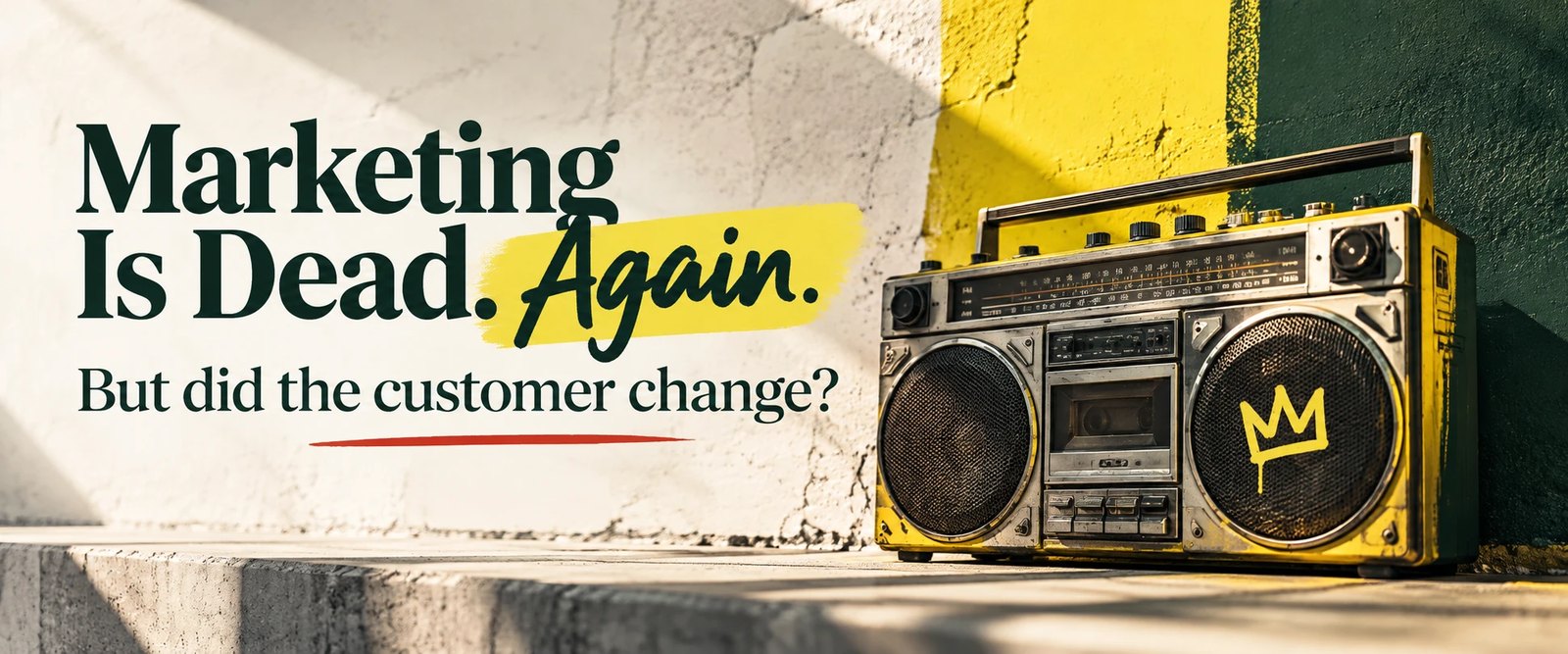
In 2006, Nas released Hip Hop Is Dead.[1]
It was deliberately provocative. Hip hop hadn't literally disappeared. Nas was making a judgement about what the genre was becoming: the commercialisation, imitation and, in his view, declining substance surrounding the music.
Twenty years later, hip hop is very much alive.
Marketing has developed a similar habit of announcing its own death.
SEO is dead. The funnel is dead. Organic reach is dead. Traditional marketing is dead. Advertising is dead. And now, as AI changes how people search, discover and evaluate businesses, we are once again being told that the rules of marketing have changed.
Some of them have.
But before a small business tears up its marketing plan, hires another specialist or adds another platform to an already exhausting list, there is a more useful question to ask:
Is the underlying customer behaviour new, or is the mechanism through which that behaviour happens new?
The distinction matters.
Because when we confuse the two, genuinely important changes in technology can make established businesses feel unnecessarily obsolete.
The customer hasn't suddenly become a different species
Consider discovery.
Twenty years ago, someone looking for an accountant might have asked a colleague for a recommendation, searched Google, noticed an advertisement or consulted a business directory.
Today, they might ask ChatGPT, search Google, watch a YouTube video, read Reddit discussions, check LinkedIn, look at reviews and then ask a colleague.
The mechanisms have multiplied.
But underneath them sits a familiar human need:
"I have a problem. Who can help me solve it?"
What has changed is where that question can be asked, what influences the answer and how much of the evaluation can happen before the prospective customer ever reaches your website.
That matters.
It just doesn't mean everything that came before it is useless.
The same distinction can be applied elsewhere.
AI can produce dozens of advertising concepts in the time it once took to develop one. That changes the economics and speed of creative production.
It does not remove the need for good judgement about what is worth saying.
Advertising platforms can increasingly use algorithms to identify likely buyers. That changes some of the mechanics of targeting.
It does not remove the need to understand which customers create value for your business.
AI assistants can summarise products and recommend suppliers without necessarily sending someone to their websites. That changes discovery and attribution.
It does not remove the need to be credible, relevant and easy to buy from.
New mechanism. Familiar customer requirement.
That is a far less dramatic story than the death of marketing.
It is also much more useful.
| Change | New mechanism | What stays the same |
|---|---|---|
| AI search | A new discovery mechanism | The existing need to find useful answers and suppliers |
| AI creative | A new production mechanism | The existing need for relevant and distinctive communication |
| Algorithmic targeting | A changing media mechanism | The existing need to reach appropriate customers |
| AI-assisted experimentation | A faster learning mechanism | The existing principle of test, learn and improve |
So what has genuinely changed?
There is no value in pretending the changes are superficial.
Discovery has become more fragmented. Search engines are no longer the only digital interface through which people seek answers. AI systems can increasingly mediate the relationship between a customer's question and the businesses they encounter.
Content has also become dramatically cheaper to produce. That creates opportunity, but it creates competition too. Producing more material is no longer particularly difficult. Deciding what deserves to exist becomes more important.
Advertising platforms are becoming more automated. Customer data can increasingly inform optimisation. Creative can be produced and tested faster.
And businesses can learn faster because research, analysis, production and experimentation that once required considerable resources can increasingly be accelerated with AI.
These are meaningful changes.
The mistake is jumping from "the environment has changed" to "everything you know about marketing is wrong."
It isn't.
Start with the business problem, not the new tool
This is particularly important for smaller businesses.
A business with limited money, people and time cannot afford to respond to every change in marketing by adding another activity.
Before investing in AI visibility, paid advertising, a new social platform, more content or another piece of technology, ask a more basic question:
What is currently preventing more of the right customers from buying from us?
Perhaps not enough potential customers know the business exists. That is a discovery or availability problem.
Perhaps people find the business but struggle to understand why they should choose it. That may be a positioning problem.
Perhaps the proposition is clear but customers remain unconvinced. That may be a trust or evidence problem.
Perhaps plenty of qualified prospects enquire but few become customers. That sounds more like a conversion problem.
Perhaps acquisition is healthy but customers rarely return. Before buying more advertising, investigate the product or customer experience.
And sometimes the uncomfortable answer is that the offer itself simply isn't competitive enough.
No marketing framework can make that problem disappear.
The appropriate marketing response depends on the constraint.
Don't let somebody else's disruption automatically become yours
This is where context matters.
At HubSpot's recent Unbound event, its marketing leaders described losing around 140 million website visits in a year (an 80% decline) while increasing leads by 20%.[2][3] Their experience led them to reconsider the relationship between traffic volume and commercial value.
That is worth studying.
But HubSpot built one of the world's most successful inbound marketing machines. Organic website traffic played an unusually important role in its model.
A specialist law firm winning most of its business through referrals has a different problem.
So does a neighbourhood restaurant.
So does a manufacturer selling to 150 procurement teams.
So does an online retailer dependent on paid acquisition.
A major change affecting one business model can be an early warning for another business without being evidence that every company should immediately redesign its marketing around it.
The useful question is:
Does this change affect how our customers discover, evaluate, choose or buy from us?
If the answer is yes, investigate it.
If the answer is no, don't manufacture urgency simply because everybody else is talking about it.
You don't need to be everywhere
This becomes especially important when discussing modern discovery.
Google. ChatGPT. Instagram. TikTok. YouTube. LinkedIn. Reddit. Reviews. Marketplaces. Newsletters. WhatsApp communities.
Presented as a list, modern marketing can sound terrifying.
So don't start with the list.
Start with your customers.
Speak to ten of them.
Ask:
- How did you first hear about us?
- What did you do next?
- Where did you look us up?
- What alternatives did you consider?
- What nearly stopped you choosing us?
- What eventually convinced you?
Then compare those answers with whatever evidence you already have: website analytics, search queries, CRM records, enquiries, reviews, sales conversations and customer-service questions.
You are not trying to construct the world's most sophisticated attribution model.
You are trying to understand how people actually find and choose your business.
That tells you which changing mechanisms deserve your attention.
Treat new marketing advice as a hypothesis
The next time somebody tells you that your business needs 20 advertising creatives a month, needs to publish every day, needs an AI-search strategy or needs to abandon the funnel, resist two equally unhelpful reactions.
Don't dismiss it because it sounds fashionable.
And don't adopt it because you're afraid of falling behind.
Ask:
- For what type of business?
- Under what conditions?
- What evidence supports this?
- Does the underlying change affect our customers?
- What would we expect to improve if we adopted it?
Then run the smallest useful test.
If customers are increasingly discovering your category through AI assistants, investigate whether your business appears in relevant answers and what sources those systems rely upon.
If an advertising platform's automated targeting appears promising, test it against your current approach with an appropriate budget and measurement method.
If customers increasingly evaluate suppliers through video, test whether useful video content improves discovery or conversion before building a studio and hiring a production team.
You do not need certainty before acting. You need a reason for the experiment.
Measure the change you were trying to create
This also helps resolve another marketing argument: the supposed death of "vanity metrics".
Reach isn't inherently vanity.
Neither are impressions, traffic, engagement or followers.
They become misleading when they are presented as evidence of business success without explaining what role they were supposed to play.
If your problem is that too few potential customers know you exist, increased reach among the right audience may be useful evidence.
If your problem is poor conversion, celebrating increased reach probably misses the point.
If your objective is retention, website traffic might barely matter.
The metric should follow the problem.
Not the dashboard.
What should a small business do now?
Not everything.
That may be the most important advice.
You don't need a "new marketing playbook" every time the industry acquires a new piece of technology.
Instead, periodically examine four things:
- What has changed in our customers' behaviour?
- What has changed in the mechanisms through which they discover, evaluate and buy?
- Which of those changes materially affects our business?
- What should we test or change as a result?
Then identify the most important constraint on growth and work on that first.
- If discovery is the constraint, improve discovery.
- If recognition is the constraint, build mental availability.
- If trust is the constraint, strengthen your evidence.
- If conversion is the constraint, improve the buying experience.
- If retention is the constraint, investigate the customer experience.
If none of those is the constraint, don't create a marketing problem simply because the industry has found a new vocabulary for one.
Marketing isn't dead
Neither was hip hop.
What changes are the sounds, tools, distribution systems, economics and cultural contexts surrounding it.
Marketing is experiencing something similar.
AI is changing discovery. Algorithms are changing distribution. Automation is changing production. New interfaces are changing how customers research their options.
Those changes deserve serious attention.
But businesses still need to be noticed, understood, believed, chosen and remembered.
The mechanisms will keep changing.
Our job is not to chase every one of them.
It is to understand which changes alter the way our customers make decisions, and respond when they do.
Because the question facing a small business in 2026 isn't:
"Have the old rules of marketing died?"
It is much more practical:
"What has actually changed for our customer, and what, therefore, should we change?"